The 2 A.M. Search History: Turning Late-Night Health Googling Into Better Appointments
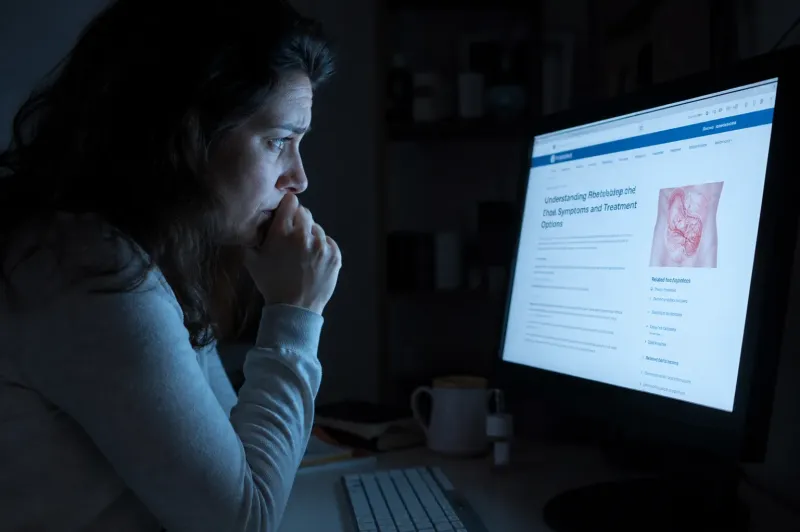
Photo: person searching health symptoms on laptop at night worried, via agmazon.com
It is a familiar scene at any community clinic: a patient arrives with a printed list of possibilities, a screenshot or two, and a slightly apologetic tone. "I know I shouldn't have Googled it," they say, almost before sitting down.
We would like to retire that apology. In our experience, patients who research their symptoms are not a problem to be managed — they are people paying attention to their own bodies. The question is never whether you searched. It is what you did with what you found.
Why the 2 A.M. Search Happens
Symptoms rarely announce themselves at convenient hours. A strange sensation appears on a Saturday night, the clinic is closed, and the search bar is the only thing awake with you. For many Americans — particularly the roughly one in four adults in rural counties facing physician shortages — the internet is the first available clinician, even if an unqualified one.
Late-night searching is also, at its root, an act of care. People look up symptoms because they are worried about themselves or a child, and because they want to walk into an appointment with some sense of what to ask. That instinct deserves respect, not condescension.
Where Online Research Genuinely Helps
Used well, health searches can improve your care in concrete ways:
- Prepared questions. A patient who has read about a condition often asks sharper questions and leaves with a better understanding of the plan.
- Symptom tracking. Reading about what doctors look for helps you notice patterns — when the headache started, what makes it worse — that make your visit more efficient.
- Follow-through. Understanding why a treatment matters makes patients far more likely to finish the antibiotics or attend the follow-up.
- Advocacy. Research helps caregivers speak up for aging parents or children who cannot describe their own symptoms.
Where It Goes Wrong
The trouble begins with how search engines work. Algorithms surface content that gets clicks, and alarming possibilities get clicks. A search for "headache and fatigue" can plausibly return everything from dehydration to a brain tumor, with no way to see which is statistically likely.
Three specific pitfalls show up repeatedly:
- Anchoring on the scariest result. Rare but dramatic conditions dominate health content. Patients fixate on the one-in-a-million diagnosis and dismiss the common, boring explanation their clinician later offers.
- Stacking symptoms that don't belong together. A week of poor sleep plus ordinary bloating plus a stressful month can read like a serious illness when entered into a symptom checker one line at a time.
- Delaying care. Perhaps the most serious error: deciding "it's probably nothing" based on a forum thread, when a same-day visit was warranted.
A Practical Framework for Judging a Health Website
Before you trust what you read, run it through five quick checks:
- Who wrote it, and what are their credentials? Look for named authors with medical or scientific backgrounds, and a reviewed-by date.
- Is the source identifiable? Reputable pages cite recognized bodies such as the CDC, the National Institutes of Health, or peer-reviewed journals.
- Is it trying to sell you something? Content attached to a product page deserves extra skepticism.
- When was it last updated? Medical guidance changes; a page untouched since 2017 may be outdated.
- Does it acknowledge uncertainty? Trustworthy health writing admits nuance. absolutist claims ("this ONE food cures...") are a red flag.
Sites maintained by major academic medical centers, government health agencies, and established professional organizations generally clear these bars. Random forums and anonymous blogs generally do not — though forums can still be valuable for the experience of living with a condition, once you already have a diagnosis from a clinician.
Red Flags That Mean Stop Searching and Be Seen
Some symptoms should end the research session and start a phone call — or a trip to the emergency department. Seek urgent care for:
- Chest pain or pressure, especially with shortness of breath, sweating, or arm or jaw discomfort
- Sudden weakness, facial drooping, confusion, or difficulty speaking (remember the acronym FAST for stroke)
- Difficulty breathing that is new or worsening
- The worst headache of your life, or one unlike any you have had
- Uncontrolled bleeding, severe abdominal pain, or persistent vomiting
- Suicidal thoughts — in the US, calling or texting 988 connects you to immediate support
No search result, reassuring or otherwise, should ever talk you out of acting on these.
How to Bring Your Research Into the Exam Room
Done right, your homework becomes an asset to the visit rather than a detour. A few habits we appreciate seeing:
Lead with symptoms, not conclusions. Open with what you have felt, when it started, and what changes it. Save the diagnosis list for later — it lets the clinician evaluate fresh rather than spend the visit arguing with a webpage.
Bring it short. A one-page summary beats a forty-page printout. Note your top questions (three is a good number) and any specific worries.
Name your fear honestly. "I read this could be a sign of something serious, and that's really what's scaring me" gives your clinician the most useful information in the room: your concern. Addressing it directly rarely takes more than a few minutes.
Ask about the research itself. A good clinician will happily tell you which sources are reliable for your condition and which to skip. That is a fair question to ask, and it often leads to better patient-education materials than any search engine provides.
A Closing Word From the Clinic
We would rather have a patient arrive over-informed than under-informed, over-prepared than silent. The internet has made every one of us a first-draft diagnostician; the clinic's job is the second draft, performed with training, examination, and context a screen cannot supply.
So keep your notes. Keep your questions. Bring them in — and let us finish the search together, in person, where it counts.